|
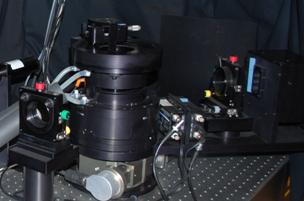 Light scattering set-up: LS-Instruments, 3DDLS-Pro Spectrometer. This equipment has the special
feature of allowing extraction of simple scattering from multiply scattering samples; this enables
measurements with rather concentrated samples. It implements the so-called \theta-2\theta strategy to reduce the
optical path inside the sample; this is achieved with the aid of a second goniometer and the use of square
cells, and maximizes the amount of simple scattering that reaches the detectors. In addition, this second
goniometer allows the rotation of the sample in order to obtain ensemble averages for non-ergodic
samples, such as crystals, glasses and gels.
Light scattering set-up: LS-Instruments, 3DDLS-Pro Spectrometer. This equipment has the special
feature of allowing extraction of simple scattering from multiply scattering samples; this enables
measurements with rather concentrated samples. It implements the so-called \theta-2\theta strategy to reduce the
optical path inside the sample; this is achieved with the aid of a second goniometer and the use of square
cells, and maximizes the amount of simple scattering that reaches the detectors. In addition, this second
goniometer allows the rotation of the sample in order to obtain ensemble averages for non-ergodic
samples, such as crystals, glasses and gels.
|
|
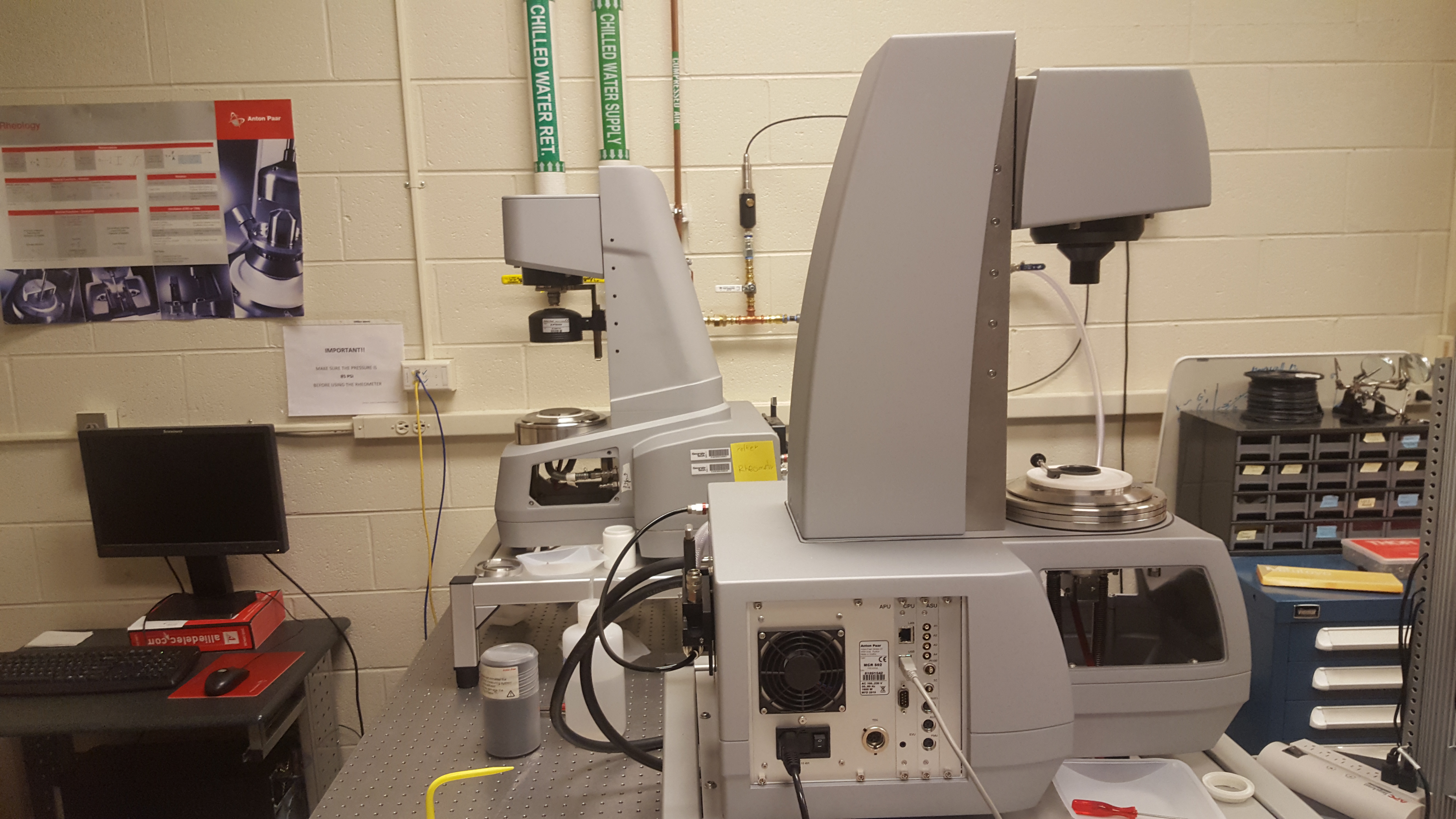 Rheometer: Anton-Paar, Model 501 and 502 with temperature control (Peltier) and various geometries (cone-plate, plate-plate, Couette, double Couette). The equipment can operate in steady and oscillatory modes and can apply stress, strain, or shear-rate. This allows for a wide range of experiments relevant to studying the mechanical properties of soft systems. We can also image the sample during experiments with a rheo-microscope.
|
|
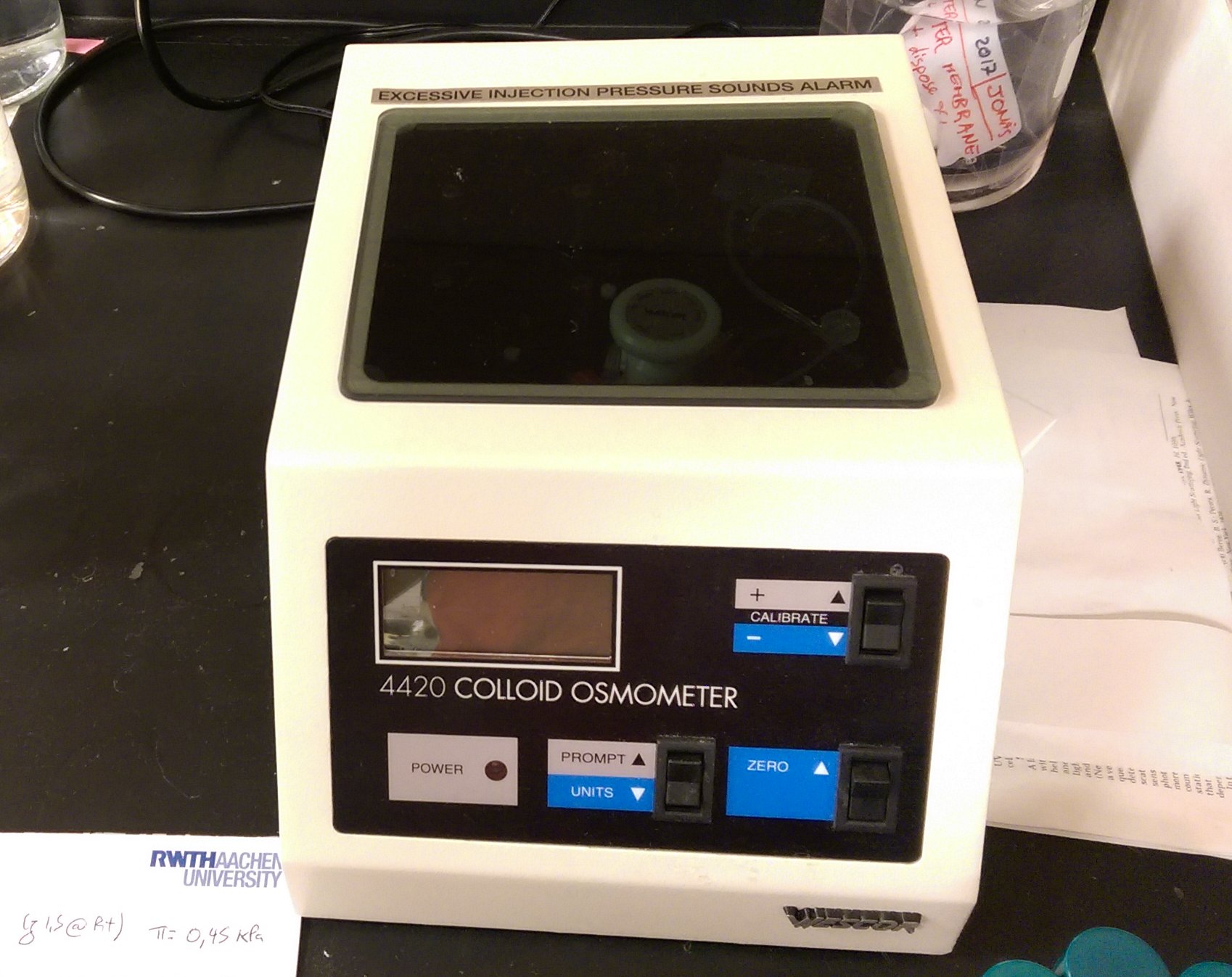 Wescor 4420 Colloid Osmometer: It is comprised by two chambers separated by a membrane that allows the diffusion of solvent molecules (typically water) but not colloids. A pressure transducer displays the pressure difference between the two chambers felt by the membrane.
|
|
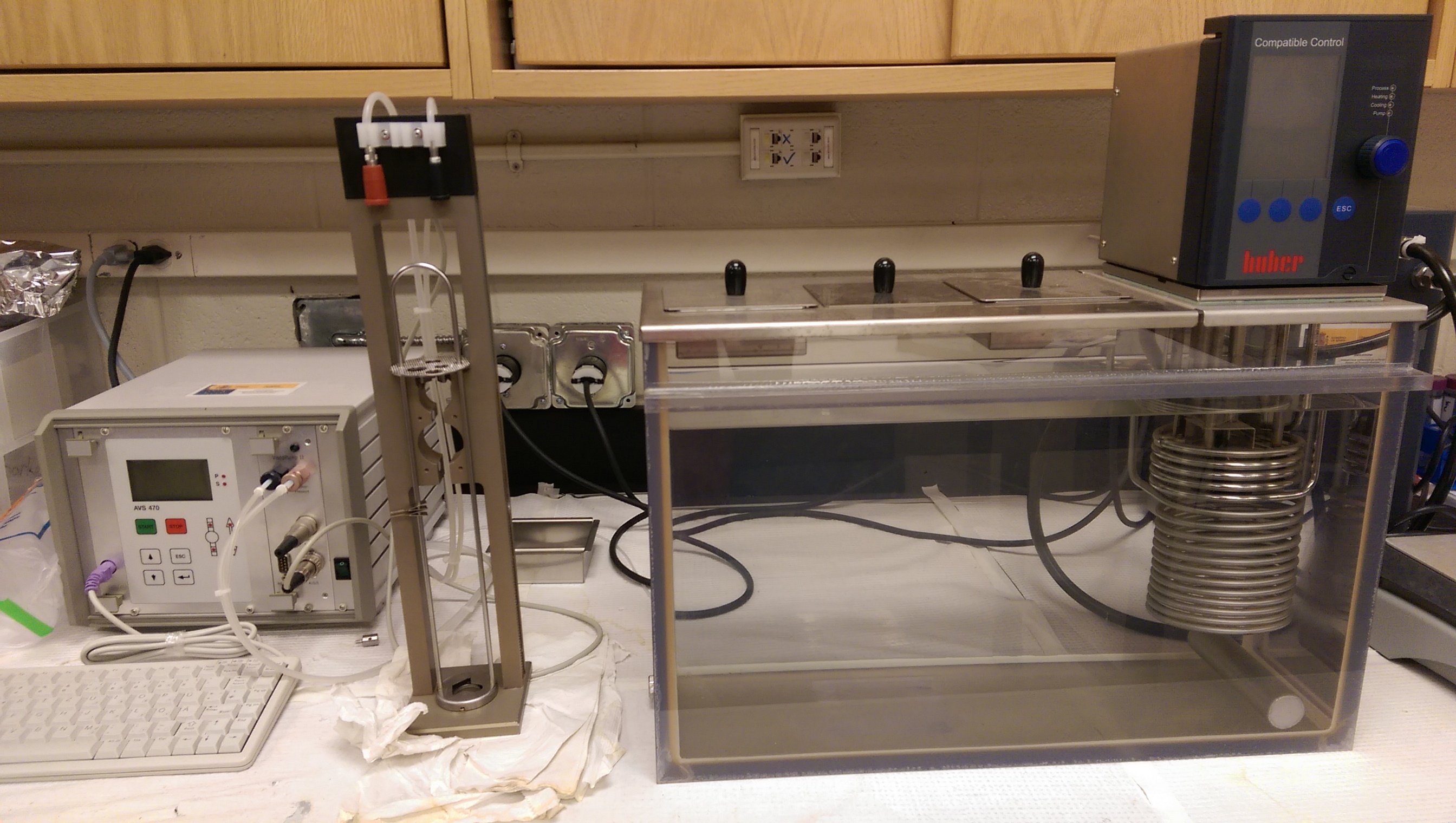 Ubbelohde Viscometer: manufactured by Technical Glass Products, Inc. They allow the measurement of kinematic viscosities of liquids between 0.6 and 30,000 cSt. The viscometer is immersed in a water bath that allows for a controlled constant temperature through the measurement.
|
|
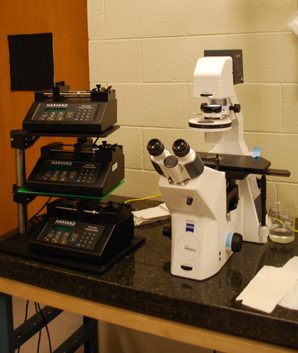
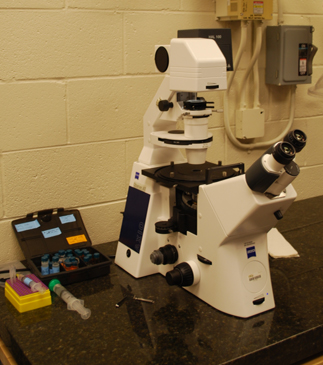
Optical microscopes:Carl Zeiss, Axio-observer A1, DIC, polarization, various objectives 5x, 10,
40x, 63x, 100x (including long working distance objectives).
|
|
High speed cameras:
- High speed camera + laptop: Vision Research, Phantom v7.1 Camera (Memory 2 GB ~ 0.6 seconds).
- High speed camera + laptop: Vision Research, Phantom v9.1 Camera.
|